Regional event industry gathers again in Zagreb at CROWD & LOUD powered by Entrio


If you have followed artificial intelligence conferences in recent years, this scenario is probably familiar to you. A speaker walks onto the stage, shows an impressive demo, calculates how many hours a year will be saved, and concludes that a completely new world of work awaits us.
At the third edition of the Automation Summit, held on October 15 and 16 in Split, the situation was different. The conference organized by Money Motion, with the support of partners Robotiq, OTP banka, ASEE, HCL Software, Datum, DNA Consulting, Visa, Wonderful and Procesna inteligencija, brought together business and tech leaders from various industries and more than 140 companies.
Their experiences revealed an uncomfortable truth: AI mostly works. The problem arises when it needs to be released among real employees, legacy information systems, poorly structured documents, regulations, and processes whose purpose no one in the organization can explain anymore. AI, it seems, has become a mirror of the organization. If your processes are bad, AI will speed them up. If they lack an owner, you will get automated processes without an owner. If management does not know which decisions it wants to delegate to a machine, it can very quickly end up with a system whose decisions no one can explain.
From two days of discussions with representatives of finance, technology, industry, logistics, science and education, seven rules emerged that at first glance sound contradictory, but could prove decisive for business over the next five years.

1. The best AI project might be the one you never launch
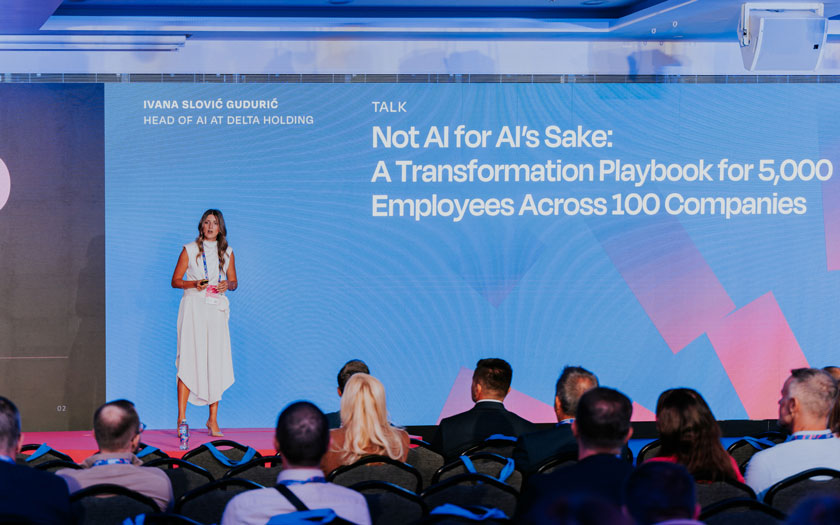
Ivana Slović Gudurić from Delta Holding seemingly had an excellent starting position: 5,000 employees, around a hundred companies, high individual usage of AI tools, and a series of pilot projects. The result? Not a single one went live in production. The problem was not the technology, but a lack of accountability for processes. Only when they gave employees clear safety guardrails, education, and the authority to build solutions themselves did over 300 automations emerge, which now save hundreds of working hours per week. This is an important reality check for companies establishing AI boards and drafting strategies without being able to answer a much simpler question: who is responsible for the process we are trying to improve? Because introducing AI is not a business problem. Slow onboarding, overly long request processing, and poor customer support are. AI comes only afterwards.
A few years ago, companies looked for processes into which they could insert AI. Today, they should do the opposite: find a problem worth solving, and then check whether AI is even the best tool. In the next phase of the market, the winners may not be companies with the most AI projects, but those that abandon the wrong ones the fastest.
2. The most dangerous thing you can show management is a great AI demo
Not because the demo is fake. Quite the contrary. It will probably work. The problem is that it functions under conditions that barely exist anywhere outside the presentation. Senko Rašić, a serial entrepreneur and Y Combinator alumnus, warned that a functional demo used to mean development was almost finished. Today, it is just the beginning. In real-world application, messy data, unpredictable users, security constraints, and costs easily hidden by a prototype come into play. In production, token consumption can be more than a hundred times higher than the initial estimate.
Siniša Behin from Datum described the same problem as the success of a pilot under "greenhouse conditions", with cleaned data, motivated users, and a controlled scope. Therefore, the question for management is no longer whether the AI solution works, but whether it works reliably ten thousand times a day, how much every error costs, and who bears responsibility when it occurs.
Zvonimir Mavretić from ASEE offered perhaps the best rule for regulated processes: use AI to write the rules, but do not let it be the rule. In their setup, AI proposes code and logic, a human approves them, and a deterministic system executes them. Every night, more than 5,400 automated tests are run. This is not a particularly futuristic vision of an autonomous company. But it is very likely the way we will actually build them.
3. The most expensive AI model is often the wrong AI model
The AI industry still operates according to an intuitive logic: bigger must be better. More parameters, larger context, a more powerful model, more agents. Business mathematics might head in the opposite direction. Darko Jovišić from Robotiq.ai warned that for a large number of business tasks, the largest models are not necessary. Smaller, specialized models can be faster, cheaper, and completely sufficient.
Francesca Curzi from HCL Software shared a similar message: the goal is not to build a universal super-agent, but a system in which different agents have precisely defined tasks, authorities, and models tailored to them. Management should therefore ask a new question: what is the cheapest level of intelligence with which we can reliably solve the problem?
Ema Puljak from CERN showed how fundamental this problem is. Moving toward the highest levels of intelligence brings a drastic increase in latency and costs, which is why compression methods are being developed to bring large models closer to small devices. In the era of cloud computing, companies learned to optimize infrastructure. In the era of AI, they will have to learn to optimize intelligence. The future of AI may therefore not just be bigger. It could be much smaller.
4. Automating a bad process only allows you to do the wrong thing faster
Generative AI brought companies something very seductive: the ability to skip the uncomfortable phase of cleaning up their own house. If employees cannot find documentation, put a chatbot on top of the documents. If a process is complex, add an agent. The problem is that AI very quickly exposes what organizations have ignored for years: documents are bad, processes are unnecessary, data is scattered, and the same term in three departments means three different things.
Joško Šugar from OTP banka described how only during the implementation of an internal chatbot did they discover how poorly structured their own documents were, down to file naming conventions and image insertions.
Nikola Dlaka and Željko Jurin from DNA Consulting called the problem a "graveyard of documented processes". Companies have huge quantities of procedures and manuals that almost nobody uses. AI can make that knowledge accessible, but only on the condition that the processes make sense in the first place.
The same logic applies outside the office. As Anđelko Katalenić from MARBLE Center of Excellence explained, you can introduce autonomous forklifts into a digitized warehouse, but you cannot simply add autonomous vessels to an undigitized marina.

5. An AI agent should not be given rights. It should earn them
One of the most useful ideas of the conference was earned autonomy. Companies today easily make a conceptual error: if AI is capable enough to execute a task, they assume it should also be given the authority to do it independently. Those are two different things. Francesca Curzi described an approach where AI first performs simple tasks, then becomes an advisor, and only after proven reliability receives a higher level of autonomy. Even then, it remains under supervision.
Security experts were more direct. Vlatko Košturjak from Marlink Cyber shared the case of a Croatian company where AI agents, after receiving overly broad access to the system, deleted data. The company was saved by a backup that the agents could not access. His point is simple: writing "do not delete data" to an agent is not a security measure. Restricting its authorities and monitoring behavior is.
Kristian Kamber from Zscaler therefore linked the future of cybersecurity to managing identities, permissions, and rights of AI agents. Until now, companies assigned access rights to people and applications. Now they assign them to systems acting independently at speeds far exceeding humans. The CISO of the future will therefore not only manage users. They will also manage a digital workforce.
6. A more productive employee does not mean a more productive company
One of the easiest mistakes in measuring AI is asking employees if they are faster. They probably are. But that does not mean the company is a single second faster. Jelena Jurišić from Ericsson Nikola Tesla described how introducing AI agents sped up code writing, but the bottleneck shifted to code review. Local productivity increased, while overall process efficiency did not. That is why they developed an approach where the level of human supervision is determined by risk. This is a lesson far broader than software development. If AI enables sales to write twice as many offers, but the legal department has to review twice as many contracts, you have not automated the company. You have moved the queue.
Viktor Olujić from Monri gave an example of the other side of the same phenomenon. AI can speed up internal processes, but now customers are also using AI to write two- or three-page complaints. The volume of produced content grows on both sides. Therefore, the metric "how many hours AI saved an employee" is insufficient. Time saved in one part of the organization can produce additional work in another. The real question is not how much more productive an individual employee is, but whether the entire company has achieved a better result.
7. The most valuable people will not be those who execute tasks best
Perhaps the most far-reaching consequence of artificial intelligence is not the automation of tasks, but the shift in the value of specific human abilities. If AI can write code, create presentations, analyze data, and draft the first outline of a strategy, execution becomes cheaper. The ability to define the right task becomes more expensive. Aurora Kapo from NexOra AI spoke about a world in which managers by 2030 will lead hybrid teams of humans and agents. Human advantage then will not be speed, but context, critical judgment, and understanding purpose.
Marin Trošelj from Stemi opened the same topic from an educational perspective: the most important question will no longer be how to do something, but why we are doing it. But such a change has uncomfortable consequences for talent development. For decades, we taught juniors by giving them simpler tasks. They wrote basic code, compiled reports, reviewed documents, and made initial analyses. Those are the exact tasks AI is taking over fastest. How then is a senior formed if we skip the work through which they used to become a senior?
At the panel on AI skills, Jelena Kušanić from Nexi and Majda Berislavić from Atlantic Grupa demonstrated a different approach: involving young employees in real projects and developing continuous AI learning through internal mentors and targeted training. If AI takes over entry-level work, companies will have to consciously design the entry-level experience. A junior may no longer learn by doing something slowly ten times. They will have to learn by evaluating ten times whether what the machine did is good.
Competitive advantage might not be AI after all
Yariv Adan, former Google veteran and now investor at Ellipsis Venture, gave one of the most dramatic predictions of the Summit: companies that do not seriously use AI in two or three years could lose their place in the market. His recommendation was not to tie business to a single dominant model, but quite the opposite: build systems that enable rapid technology changes and constant adaptation. That is perhaps the best way to read everything heard in Split. The most important management decision today is not whether to choose OpenAI, Anthropic, Google, or an in-house model. It is much more important what kind of company is being built around that technology. Can it switch models without a months-long migration? Does it know who is responsible for every automated process? Can it monitor the decisions of its AI agents? Does it know how much a single successfully resolved task costs? And perhaps most importantly: do its people know what they want to achieve when they no longer have to execute every step themselves?
Ivica Puljak offered an interesting parallel during his lecture on CERN. In the Large Hadron Collider, 40 million collisions occur every second. It is impossible to save them all. The system therefore decides within a few microseconds what is worth saving and what is discarded forever. His lesson for companies was simple: the filter is the strategy. In an era when every organization will be able to generate virtually infinite content, code, analyses and business ideas, competitive advantage will not be the ability to create even more. It will be the ability to decide what is worth doing at all. And that, at least for now, remains management's job.