Maja Rusan reveals why business events and the charity sector have more in common than we think


New research conducted by Northstar Meetings Group and Cvent reveals that the current geopolitical instability, particularly conflicts in the Middle East, is having a strong impact on the mindset of event organizers across the Europe, Middle East and Africa (EMEA) region. Still, despite increased caution and shifts in strategy, the industry is not slowing down – it is adapting.
The research is based on the global Meetings industry PULSE Survey, conducted in March 2026, with a total of 825 event organizers from three regions – North America, EMEA and Asia Pacific. Of these, 174 respondents came from the EMEA region, which is the focus of most of the findings, while certain aspects such as sustainability and virtual formats are compared globally. The sample was predominantly agency-based, but balanced across PCOs, corporate organizers and association planners, providing a relevant cross-section of the industry.
Shorter lead times and more cautious decisions – insights from Croatia
One of the most pronounced trends, and one that has already been gaining momentum, is the shortening of planning timelines. Fewer and fewer events are being booked a year or more in advance, while activity is shifting into a shorter window of 3 to 9 months before delivery.
This shift clearly reflects market uncertainty – organizers want to retain flexibility and reduce exposure to risk. At the same time, the share of those still in the research or rebooking phase is growing, suggesting additional caution in final decision-making.
The fact that these global trends have not bypassed Croatia was also confirmed by stakeholders from the country’s business events industry. Lana Radolović Jakus of Valamar Riviera says: „This trend has not bypassed the Croatian market either – in recent months, we have seen many last-minute inquiries from corporate clients for events and smaller meetings. Larger congresses are still planned in advance, but even there we can see caution in planning details and additional services due to global uncertainty.“
From the agency perspective, however, the picture is even more challenging. Daniel Marušić of the agency DT Croatia - Dubrovnik Travel DMC emphasizes that clients are becoming more cautious, budgets are under pressure and terms of cooperation are increasingly strict: „The changes are visible at every level – from the nature of inquiries to budgets. Clients are trying to protect their interests as much as possible and often shift risk onto agencies. At the same time, we are recording more postponements, cancellations and budget cuts.“
He also points to deeper structural challenges facing the industry: „While service providers and clients are focused solely on protecting their own interests, agencies remain the unprotected link in the chain, faced with unrealistic expectations, a decline in service quality and the high costs of a slow public sector. This unsustainable system, in which responsibility for saving the season is constantly shifted onto small entrepreneurs, undermines destination perception and the market’s long-term stability.“
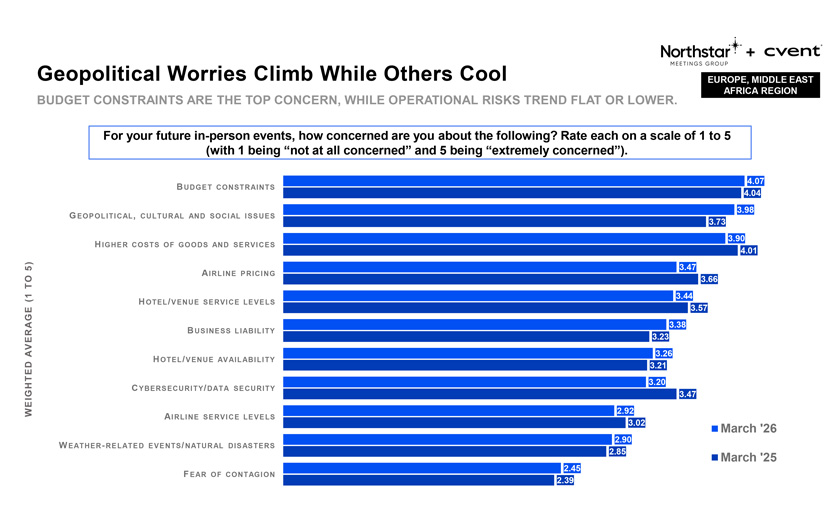
Geopolitical risks are now among planners’ top concerns, alongside budget constraints, which remain near the top of the list of challenges. Travel safety, costs and the potential disruption of destination accessibility stand out as particular concerns.
Sanja Vukov-Colić of Spektar putovanja emphasizes: „We could say that the Croatian market in 2026 still has stable demand, but only those businesses that can adapt quickly and deliver clear value within ever shorter timeframes will be successful.“
The value of in-person meetings remains unquestioned
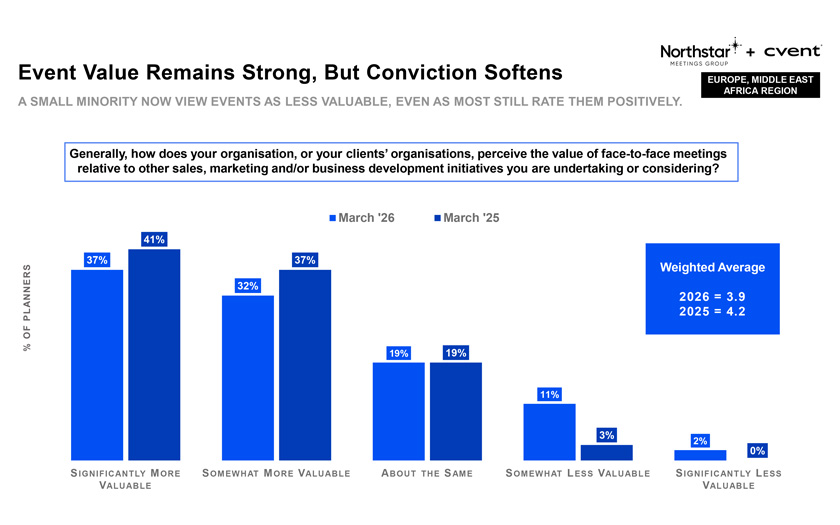
Despite all the challenges, physical events continue to play a critical role. As many as 69% of respondents believe that live events are equally or more valuable than other business activities.
Networking remains the leading reason for organizing events, ahead of education, sales or team building. This confirms that, despite digital alternatives, personal contact remains an irreplaceable element of business communication.
Still, a slight drop in enthusiasm is visible – the average perception of event value fell from 4.2 to 3.9 (on a scale of 1 to 5), pointing to a more cautious approach and the need for clearer proof of return on investment (ROI).
The survey also points to an interesting geographical shift – as many as 64% of respondents are now less inclined to organize events in the United States, most often due to visa restrictions, security concerns and the political context.
When it comes to expectations regarding attendee numbers, planners are far more restrained than in previous years. A growing share now expects stagnation or even a decline in attendance compared with earlier years.
„We must be prepared for lower attendance at events, more modest destinations and hotel categories, the avoidance of more upscale tourism centres, and a stronger emphasis on the price and organizational advantages of holding events in less attractive periods of the year“, says Sanja Vukov-Colić. She also added that, although the need for in-person events remains strong, hybrid events could begin to grow again if the right revenue-cost balance is achieved, both because of uncertainty and travel constraints and because of tighter budgets.
Operational conditions are stabilizing – good news for suppliers
Unlike geopolitical and financial challenges, operational conditions are showing signs of improvement. Issues such as high accommodation costs, F&B prices or rigid contracts are down compared with last year. This is also confirmed by Croatia’s hotel sector – according to Lana Radolović Jakus, prices have stabilized to some extent, but flexibility and adaptability are now the key to success: „Clients are looking for value for money more than ever. We often find creative solutions, move beyond standard frameworks and offer personalized options – that is what makes the difference.“
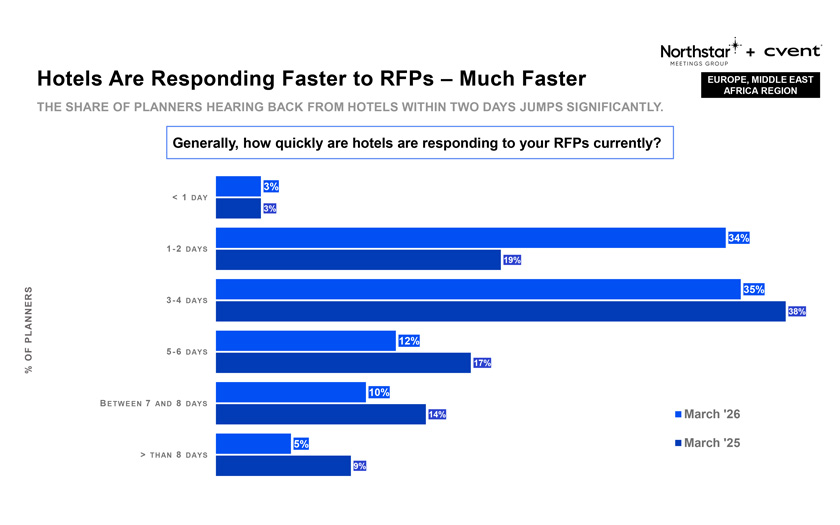
Particular progress can be seen in the hotel sector when it comes to response times to RFP (request for proposal) inquiries, which are now being handled within 1 to 2 days, while planner satisfaction increased only in the hotel category among all supplier groups.
„This very uncertainty in the market, in this specific sales segment, requires additional flexibility on our side and, of course, speed in responding to inquiries. Even so far, our first return contact/communication with clients has taken place within 24 working hours of receiving the inquiry, but we strive to do it even faster, within the same working day. Practice has shown that this is often the key factor in the final confirmation of an event, because that first reaction actually signals how we work and what level of professionalism clients can expect“, Radolović Jakus points out.
This trend represents an opportunity for hotels and venues to further strengthen their position as key partners to organizers, especially in conditions of increased uncertainty.
If you would like to check whether hotels and venues in Croatia are truly responsive, try our free Event Assistant tool and send an inquiry for your next event today – to multiple properties at once.
An industry in adaptation, not stagnation
The research clearly shows that the events industry is entering a phase of redefinition, in which agility, flexibility and risk management are becoming key competencies. For destinations, hotels, venues and PCO agencies, this means the need for a more proactive approach: faster communication, more flexible terms and clear responses to safety and cost concerns are becoming decisive factors of competitiveness.
While the global situation remains uncertain, one thing is clear – the need for in-person meetings has not disappeared. It is simply evolving in line with a new set of rules.