Geopolitics is reshaping the rules of the game: event organizers grow more cautious, but demand remains resilient


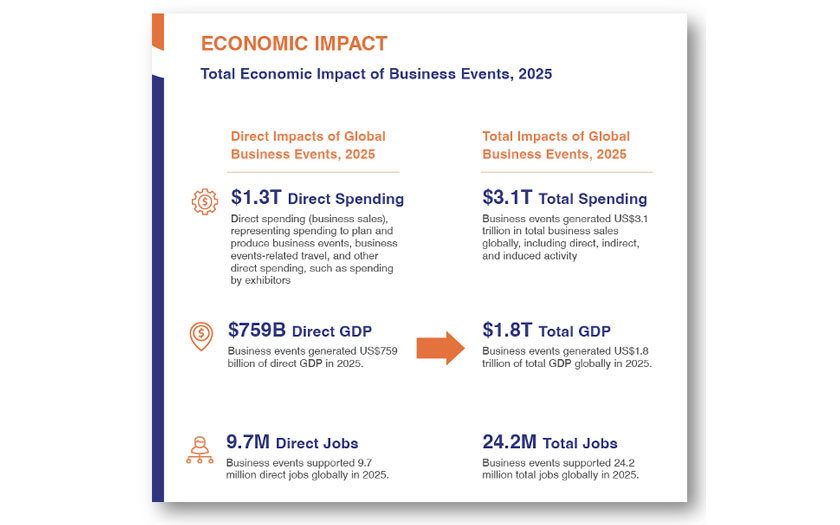
Business events today are much more than conferences, congresses, trade shows and corporate gatherings. According to the latest research, "2026 Global Economic Significance of Business Events", jointly conducted by the Events Industry Council (EIC) and Oxford Economics, the business events industry generated as much as 1.3 trillion US dollars in direct spending in 2025 and supported a total economic impact worth 1.8 trillion dollars in GDP and 24.2 million jobs worldwide.
The results of the research, which covers more than 180 countries, once again confirm what event organisers, hoteliers, convention centres and destinations have been pointing out for years – business events are not an expense, but an investment that creates long-term value for the economy and society.
During 2025, business events brought together as many as 1.65 billion participants, which is one per cent more than before the pandemic, while direct spending related to events was 12.2 per cent higher than in 2019. The average spending per participant amounted to 785 US dollars, and trade show events alone generated 180 billion dollars in direct spending.
When analysing the structure of spending by region, it is evident that North America and the Asia-Pacific region hold the leading positions. North America leads with 488 billion dollars in direct spending (with 336 million participants), followed by the Asia-Pacific region with 353 billion dollars in spending, although it records the largest number of participants – as many as 608 million. Western Europe also holds a high share with 328 billion dollars in spending and 447 million participants. On the other hand, the Central and Eastern Europe region, to which Croatia belongs, achieved 34 billion dollars in direct spending through 69 million participants. The importance of the trade show industry was also particularly highlighted, as it independently generated 180 billion dollars in direct spending globally.
Greater economic impact than air transport and the telecommunications industry
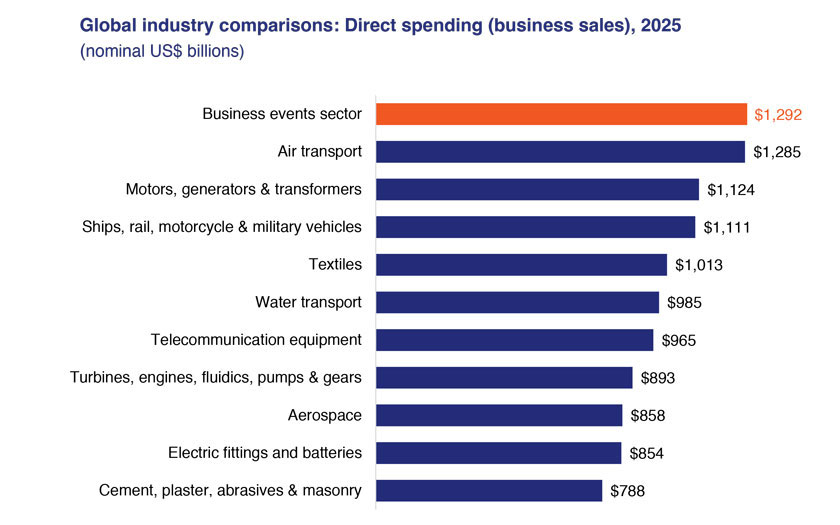
One of the most interesting conclusions of the research is the comparison of the business events industry with other major economic sectors. Direct sales generated by business events in 2025 amounted to 1.3 trillion dollars, which is more than a number of traditionally strong industries such as air transport, telecommunications equipment, the textile industry or aerospace manufacturing. This includes indirect and induced impacts through supply chains and employee spending.
Even more impressive is the fact that the total GDP generated by the business events sector, if viewed as a separate economy, would be the 16th largest economy in the world. With a total contribution of 1.8 trillion dollars to GDP, the sector would rank ahead of economies such as Turkey, Indonesia, the Netherlands or Saudi Arabia.
For destinations investing in convention infrastructure, convention bureaus and the development of business tourism, these data represent a strong argument in favour of further investment. Business events create spillover effects across the entire local ecosystem – from hotels, convention centres and restaurants to transport providers, technical suppliers, marketing agencies and numerous other activities.
Unfortunately, in Croatia, there are no recent or comprehensive official data on the economic impact of business events. In 2015, the Croatian Bureau of Statistics stopped systematically tracking the number of business meetings and the revenue generated from them, which is why the domestic industry today lacks precise indicators regarding the total economic contribution of congresses, conferences, trade shows and other business events. This is precisely why international research such as this gains additional value, as it demonstrates the scale of the sector's impact and can serve as an argument for re-establishing a more systematic tracking of business tourism and its importance to the Croatian economy.
An industry that employs millions of people
According to the research, business events directly supported 9.7 million jobs in 2025, while the total number of jobs related to this sector reached as many as 24.2 million.
It is important to emphasise that this does not only refer to the employees of event organisers. The industry brings together a wide spectrum of professions – from congress organisers, DMC agencies, hotel teams and convention centres to audiovisual experts, IT service providers, catering companies, transport providers, exhibition space designers, translators and marketing experts.
It is precisely because of such a broad value chain that business events have a powerful multiplier effect on the economy.
What is most valuable is difficult to measure in numbers
Although the economic indicators are impressive, the authors of the study point out that the true impact of business events often goes beyond financial metrics. The so-called catalytic effects include the creation of new business opportunities, partnership development, knowledge transfer, research collaboration, innovation, professional development as well as medical and technological advancement. Congresses, conferences and trade shows are precisely the venues where new ideas, business contacts and projects are born, often generating value for years after the conclusion of the event.
The importance of personal contact is also confirmed by a survey conducted among more than 1,600 event organisers, event venues, hotels and other industry stakeholders. As many as 70 per cent of respondents believe that relationship building through face-to-face meetings is the most irreplaceable component of an event, while an additional 12 per cent highlight the importance of trust, a sense of community and emotional connection. Participation in live events increases the visibility of organisations by an average of 37 per cent, while respondents estimate that without organising live events, they would lose as much as 28 per cent of their revenue.
Optimistic forecasts for the future
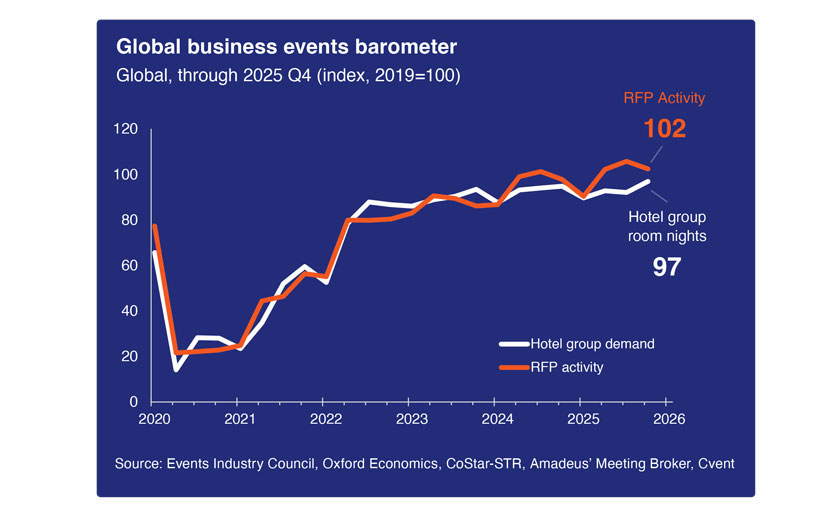
The business events industry has shown exceptional resilience after the pandemic. By the end of 2025, global activity in the business events segment had almost completely returned to pre-pandemic levels. The number of requests for proposals (RFPs) reached 102 per cent of 2019 levels, while the number of group hotel overnight stays reached 97 per cent of the pre-pandemic volume.
Forecasts by Oxford Economics further confirm this positive trend. Direct spending related to business events is expected to reach 1.6 trillion US dollars by 2028, while the number of directly supported jobs will rise to 10.4 million.
For event organisers, convention centres, hotels and destinations, this means that business tourism is entering a new period of growth, but also a period of increasingly proving its value. Business events are a key infrastructure of the modern economy that drives business development, innovation, employment and international competitiveness.
You can download the full summary of the research at the link: 2026 Global Economic Significance of Business Events.
* The study defines business events as gatherings of 10 or more participants lasting at least four hours at a contracted venue, excluding social, formal educational and recreational activities. The research process included primary research from a global survey conducted with more than 1,600 event organisers, venues, destination marketing organisations, suppliers and other industry participants, as well as an analysis of country-level studies, third-party industry data, EIC Global Business Events Barometer data and global economic and business travel forecasts from Oxford Economics.